
Stucco Types: Traditional vs EIFS & Plaster vs Stucco
Not all stucco is the same, and knowing which type is on your home helps you understand how it behaves and how it should be repaired. This guide covers the two main exterior stucco systems and clears up the common "plaster versus stucco" confusion.
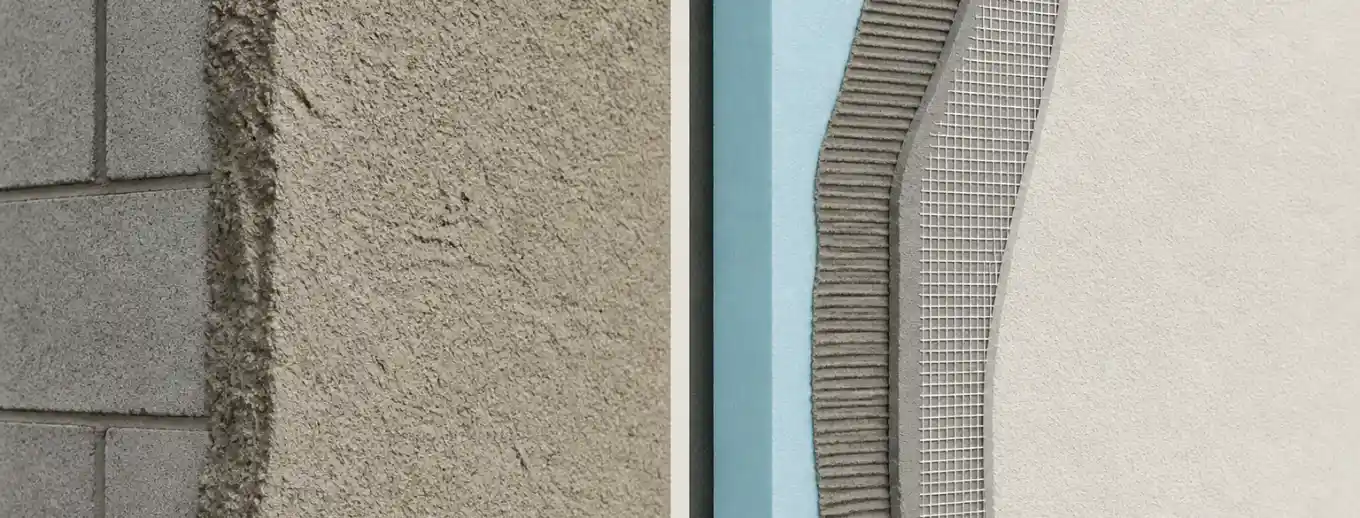
Traditional stucco
Traditional stucco is a cement-based finish applied in coats over concrete block or a lath base. It is hard, durable, and breathes at the surface, shedding water while letting the wall dry. Most Central Florida homes have this system, because it stands up well to the region's heat and humidity when it is maintained. When it cracks, the repair is a cement-based patch and a rebuilt texture to match.
Synthetic stucco (EIFS)
EIFS, which stands for Exterior Insulation and Finish System, looks similar from the curb but works very differently. Instead of a hard cement coat sitting on block, you have a sandwich: a board of rigid foam, a reinforced base coat over it, and a thin decorative finish on the outside. The consequence that matters to a homeowner is drying. A block wall that takes on water can usually get rid of it. A wall with insulation behind the finish has a much harder time, and on the older barrier systems, effectively no way at all. That makes moisture control the central issue in any EIFS repair, and it is why synthetic and traditional stucco are not repaired the same way. If your home has EIFS, see synthetic stucco and EIFS repair.
How to tell which you have
The two can look alike, but there are clues. EIFS often sounds hollow and feels slightly soft when tapped, because of the insulation behind it, while traditional stucco over block feels hard and solid. Edges at windows and trim can also differ. If you are not sure, a contractor can confirm it when they look at the wall, which matters because the repair method depends on the answer.
Plaster vs. stucco: what is the difference?
People use "plaster" and "stucco" interchangeably, and the terminology genuinely is loose - stucco is a form of plaster, and usage varies by region and by system. But for your home's exterior in Florida, the term that matters is stucco: the durable, cement-based finish built to take weather on an outside wall.
The softer gypsum-based finishes people usually mean by "plaster" belong on interior surfaces. They are a different material doing a different job, and they are not what we work on. When we talk about repairing your walls, we mean exterior stucco - the finish that protects the outside of your home.
Why the type matters for repair
Repairing stucco correctly means matching the method to the system: a cement patch and texture rebuild for traditional stucco, and a layered, moisture-first approach for EIFS. Using the wrong method, or treating one like the other, is how repairs fail early. Knowing your type is the first step to a repair that lasts.
In summary
The bottom line
Whether your home has traditional cement stucco or a synthetic EIFS system, the finish is what protects your walls from Florida weather, and each is repaired its own way.
Takeaway
To see the full range of exterior stucco work, visit our stucco repair hub, or get a free estimate. Anicette Stucco is insured, with more than 15 years across Central Florida and a 4.8-star rating from 48 Google reviews. Call (407) 456-2006 or (863) 398-3871.