
Stucco Water Damage Repair in Central Florida
Stucco water damage repair fixes the moisture that has gotten behind a stucco wall, corrects how it got there, and rebuilds the barrier that keeps it out. In Central Florida, where humidity and heavy summer rain push moisture at every exterior wall, this is some of the most important stucco work there is, because water behind the finish does not stop on its own. Anicette Stucco has repaired water-damaged stucco across Lake County for more than 15 years. We are insured and every estimate is free.
Call (407) 456-2006 or get a free estimate.
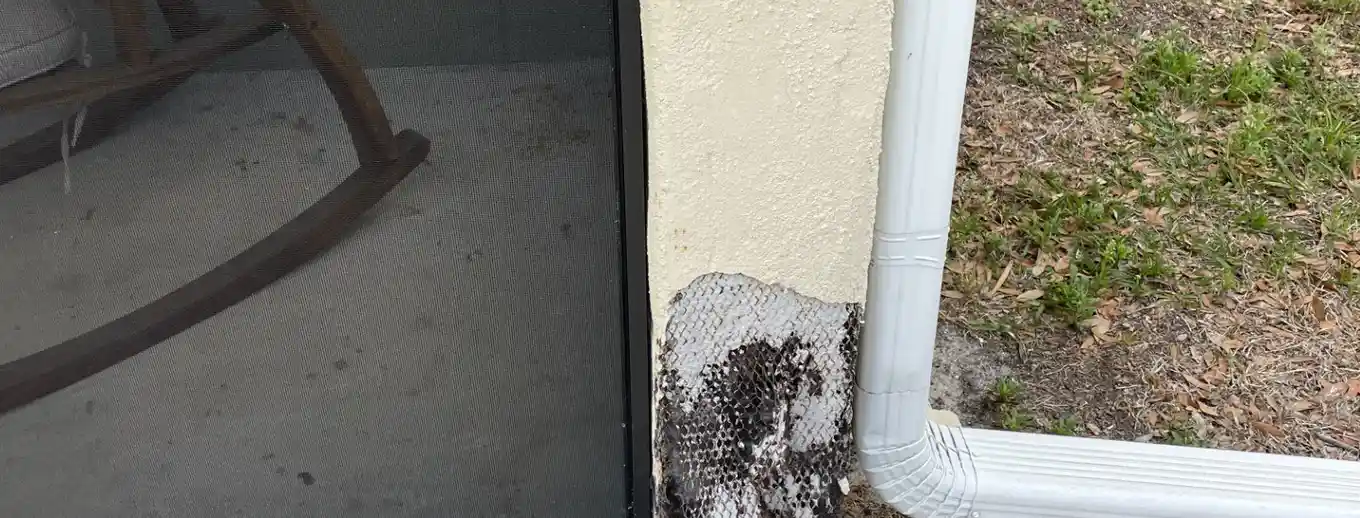
How water gets behind stucco
Stucco is meant to shed water and let a wall breathe, but once there is a way in, moisture collects where you cannot see it.
- Unsealed cracks01
- Failed caulking around windows and doors02
- Roofline and flashing gaps03
- Finishes that have lost their bond04
Storm-driven rain finds these openings, soaks the substrate, and stays there in the humid climate.
Sealing the surface at that point traps the water instead of stopping it, which is why water damage needs the cause addressed, not just the crack filled.
Signs of stucco water damage
- Staining or dark streaks on the wall, often below windows or at corners.
- Soft or spongy stucco that gives when pressed.
- Bubbling, blistering, or peeling paint and finish.
- A musty smell or interior wall damage near the exterior wall.
- Cracks that keep returning after being patched.
Any of these is a reason to have the wall looked at. None of them is a diagnosis on its own: staining can come from run-off or organic growth, and a soft area can have more than one cause. What they reliably tell you is that the wall deserves a proper look rather than a guess.
Send a photo when you get a free estimate. A photo will often tell us whether you are likely looking at a surface problem or something behind the finish, but confirming it means seeing the wall.
Our water damage repair process
Step 01 of 05
Assess and find the source.
We work out where water is getting in and how far the damage is likely to have traveled. The full extent is confirmed once the wall is opened, not before.
Where this sits in the wall
- Concrete block
- Weather barrier
- Metal lath
- Base coat
- Finish + texture
The cause is usually behind the finish, in the block or the barrier - not in the crack you can see.
Why acting early saves money
Water damage is progressive. The repair grows with it.
Scope of repair Small, localized problem
Catching it while it is a small, localized problem keeps it in the affordable range described on our stucco repair cost page.
Why the damage is bigger than the stain
The single most misleading thing about water damage is that the visible mark is almost never the extent of it.
Water enters at a gap - a failed seal, a crack, a flashing detail - and then travels.
- It runs down inside the wall.
- It spreads sideways along whatever it meets.
- It shows up on the surface wherever it happens to find its way out.
That is why the stain under your window may have nothing to do with your window, and why we trace the path rather than treating the mark.
What we usually find when we open the wall
Once the finish comes off, the story is normally obvious.
- A saturated substrate
- A moisture barrier that has failed or was never continuous
- Material that has been quietly deteriorating for a season or two
Either way, we tell you what is actually there before we rebuild, because the alternative is closing a wall over a problem you have already paid to fix.
When a returning crack is not about water
A crack that keeps coming back is usually a crack whose cause was never found, and on this page that cause is usually water. Sometimes it is not.
- 01The crack that keeps reopening is also getting wider.
- 02It steps through the block courses.
- 03It shows on the inside of the house.
- 04Doors and windows have stopped closing.
No amount of drying and rebuilding will hold it. That is a structural engineer's question and it comes before any stucco. We will tell you if that is what we think we are looking at, rather than sell you a water-damage repair for a problem that is not water.
There is no fixed rate, and anyone who gives you one is guessing. It depends on how much water is getting in, how often, and whether the wall gets any chance to dry between times. What is reliable is the direction of travel: it does not stop on its own, and every season it is left the opened area gets bigger.
Sometimes, and it usually turns on whether the water came from a sudden event or from long-term wear. That is a question for your insurer, and it is one of the cases where paying for a formal inspection with a written report is genuinely worth it.
Yes. We texture-match the new stucco to the surrounding finish.
It costs more than a simple crack because the wall is opened and rebuilt, but catching it early keeps it far cheaper than full restoration.
Yes. We come out, look at the wall, and give you a scope and a price at no charge. On water damage we will also tell you honestly where the number could move once the wall is open.
Why sealing it makes it worse
The instinct when you see a stain is to seal the surface, and it is the single most damaging thing you can do to a wet wall.
Working wall
Water gets in, and water gets out again.
Stucco works because it can dry.
Sealed while wet
You have removed the exit while leaving the entrance.
The water that is in there stays in there, and everything behind the finish keeps deteriorating out of sight.
Walls that have been sealed while wet are some of the worst we open up, precisely because the damage was hidden and given time.
Get a free water damage estimate
If your stucco is staining, soft, or bubbling, do not wait for it to spread. Call (407) 456-2006 or (863) 398-3871 or get a free estimate. Insured, more than 15 years in Central Florida, and rated 4.8 stars across 48 Google reviews.