
Stucco Repair in Tavares, FL
Tavares calls itself America's Seaplane City, and the waterfront is the point of the place. It is also the reason the stucco here takes more moisture than almost anywhere else we work.
Call (407) 456-2006 or (863) 398-3871, or get a free estimate, and we will tell you what your wall is doing.
Lake County seat
What Tavares does to stucco
Tavares is the Lake County seat, built along Lake Dora and the Harris Chain, with a downtown and residential streets that run right up to open water.
Homes that face the chain get no shelter from weather crossing it, and the humidity sitting over the water is a constant rather than a seasonal condition.
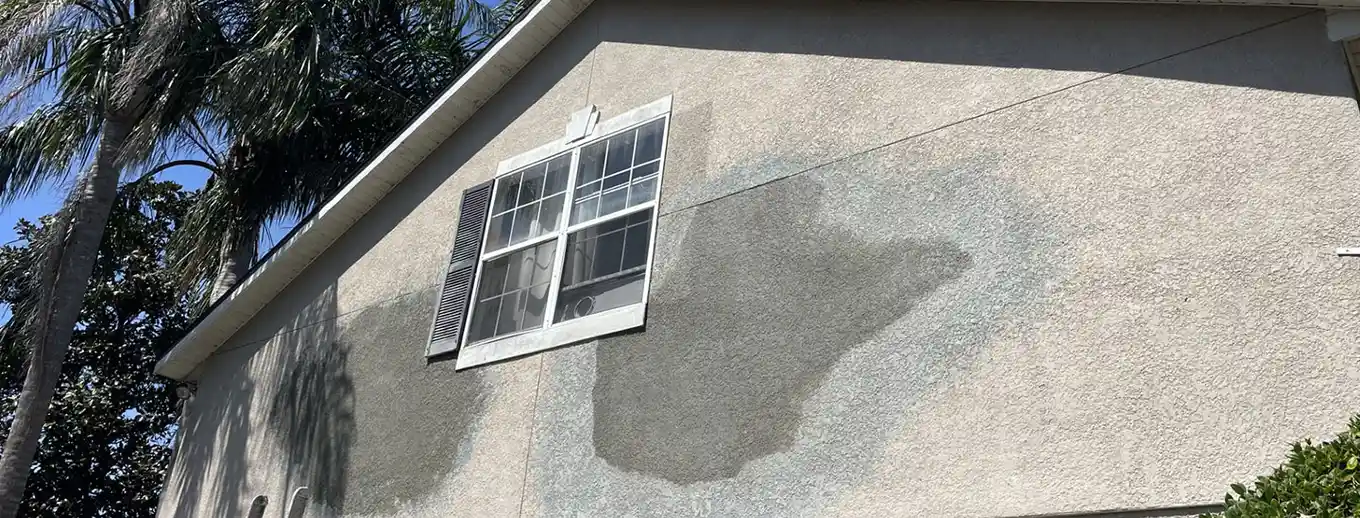
The pattern on a waterfront wall is rarely a dry hairline crack in a sheltered elevation; it is moisture that has found a way in and then very little chance to dry out again.
- Slow dryingConstant ambient humidity slows drying, so a wall that takes on water during a storm season may still be damp weeks later.
Waterfront stucco tends to fail wet. That is the condition where staining spreads, finishes delaminate, and a small unsealed crack turns into an opened wall.
What tends to go wrong on Tavares homes
Not sure which of these you are looking at? Send us a photo when you get a free estimate and we will give you an honest steer. A photo is a steer rather than a diagnosis, because what is behind a wall does not photograph, so we confirm it when we see the wall.
- Persistent moisture in walls that never fully dry between storms.
- Delamination where a finish has lost its bond to a chronically wet wall.
- Staining spreading from a single entry point across a lakeside elevation.
- Failed sealant at windows and joints on water-facing walls.
Reach Tavares easily
Finding the leak, not the stain
We reach Tavares easily from Minneola. On a waterfront home the right first step is finding where water is entering rather than where it is showing. On the chain, the visible stain and the actual leak are often several feet apart.
Our stucco services in Tavares
Whatever the cause, the method is the same: find out why the wall failed, repair the cause rather than the surface, and rebuild the finish so the repair blends into the wall around it.
- 01Stucco crack repair.
- 02Water damage repair.
- 03Holes and delamination.
- 04Full exterior restoration.
- 05Texture matching.
The whole service is set out on our stucco repair hub.
How we work on a Harris Chain home
Step 01 of 05
We start on the elevation facing the water
, because on the chain that is the wall doing the work and it is usually the wall that has been losing.
Where this sits in the wall
- Concrete block
- Weather barrier
- Metal lath
- Base coat
- Finish + texture
The cause is usually behind the finish, in the block or the barrier - not in the crack you can see.
What a Tavares repair costs
On the Harris Chain the price follows how wet the wall is, not how long the crack is.
A sheltered elevation with a dry hairline
The cheap version.
A waterfront wall that has not dried between storms
The expensive version of this job, because the drying and the barrier have to be dealt with before any stucco goes back.
The two sit at opposite ends of the figures on our stucco repair cost page, and we will tell you which one you have.
What to watch for on a Tavares home
On a wall that faces the Harris Chain, the thing to watch is not the crack but how long the wall stays dark after rain.
A sheltered elevation
A sheltered elevation dries in hours.
A waterfront one
A waterfront one, with the humidity coming off the water, can hold moisture for days, and a patch that is still dark when the rest of the house has dried is the patch worth calling about.
Check the joints around windows and doors on that elevation too, because on a waterfront home the seal usually surrenders before the stucco does. Paint that lifts or blisters on the water side is more often moisture working its way out than a coating that has failed, and it is worth having someone look before it spreads.
Water travels inside a wall. On lakefront homes the entry point is frequently above and to one side of the stain, so we trace the path rather than treat the symptom.
Yes. Constant humidity means a wet wall dries slowly, so damage that a drier inland wall would shrug off has time to spread.
That is delamination, usually a bonding failure driven by long-term moisture. It needs the wet material removed and the wall rebuilt, not a surface patch.
Yes, and those behave more conventionally, with normal settlement and weather cracking.
No. It just means the wall needs its water paths kept in order - seals, joints and flashing - rather than being left until a stain appears. Maintained, a waterfront wall holds up. Left alone, it is the side of the house that goes first.
Because a wall that can dry survives water. A wall that cannot, does not. On the chain, drying is the thing you are protecting.
The one thing water does not explain
On the chain, almost everything is water. That is the honest summary of this page. But it is not quite everything, and the exception is worth knowing.
Signs it is a structural engineer's question first
If a crack is still widening month to month, steps down through the block joints, appears in the same place on an interior wall, or turned up at the same time your doors and windows began sticking, then you are not looking at a moisture problem with a crack on top of it. You are looking at a question for a structural engineer, and it needs answering before any stucco is applied. We repair walls; we do not assess buildings, and we will tell you when the difference matters.
Book a Tavares Stucco Estimate
Call (407) 456-2006 or (863) 398-3871, or get a free estimate. We are based in Minneola, we are insured, we have repaired Central Florida stucco for more than 15 years, and we hold a 4.8-star rating across 48 Google reviews.